Home · The train window
Induced movement
The train that was not yours
You are sitting in a carriage at a platform. The train alongside begins to move. For a moment it is your own carriage that seems to slide the other way. Official wording calls this induced movement: the frame of reference has been falsely accepted. [source]
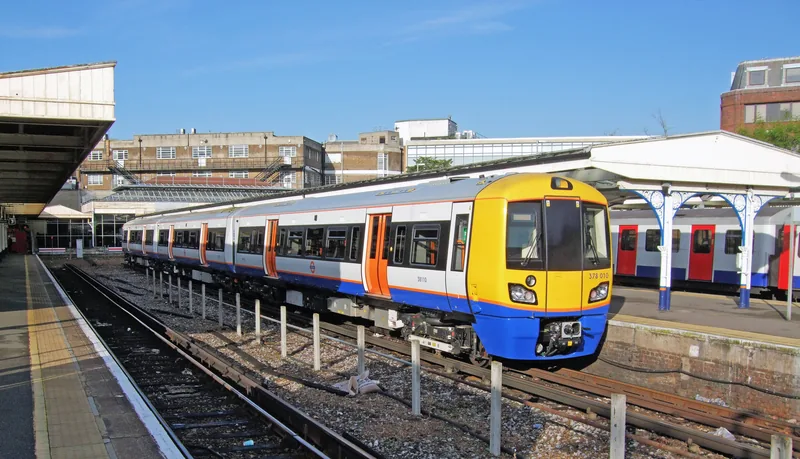
Encyclopaedia Britannica’s account is exact about the conditions. If a small object is presented in a frame with nothing else in view, movement is usually attributed to the object even when only the frame moves. A larger surround is taken as the stable world. In a station, the neighbouring train can become that frame, seen through the window, and your still carriage can seem to be the thing that moves.
The photograph of British Rail Class 378 unit 378010 at Richmond, on 8 October 2009, is a train standing at a platform, with another train under the canopy to the right. It introduces the official example. It does not itself show two trains in motion, and it does not claim that this unit was involved in anyone’s induced-movement episode. A second still, taken from a train window on the Midland Main Line on 5 October 2017, is a view through glass: fields, trees, and the edge of the frame. That is what a window shows. It is not a photograph of the illusion.
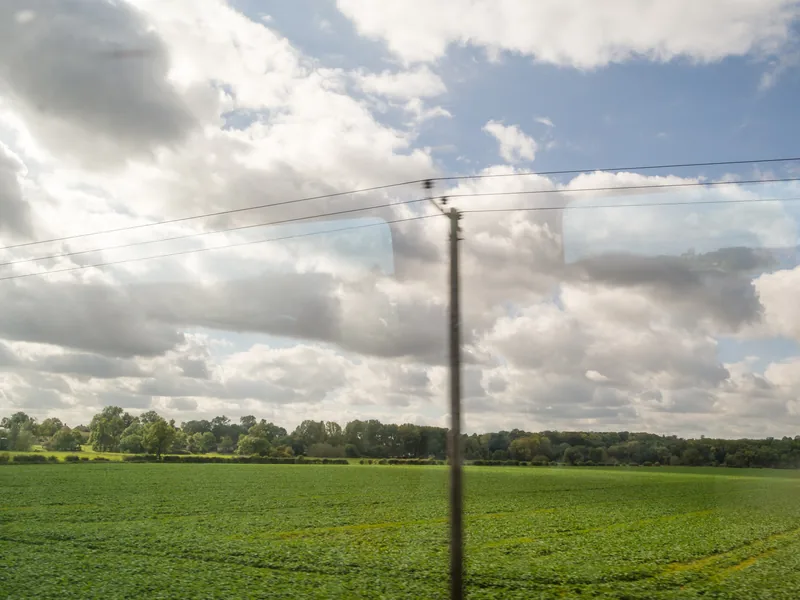
Induced movement is not the aftereffect. In the aftereffect you have been watching motion in one direction, and a still surface then seems to move the other way. In induced movement the still thing seems to move because the frame around it is moving now. The two can happen on the same journey — a parade of carriages, a window, a platform — but official wording keeps them as different members of the family, and so does this desk.
Enjoyed this desk of motion that is not quite there?
No pop-ups. No intrusive advertising. Just interesting stuff. A little support helps the next illusions.im site get built.